




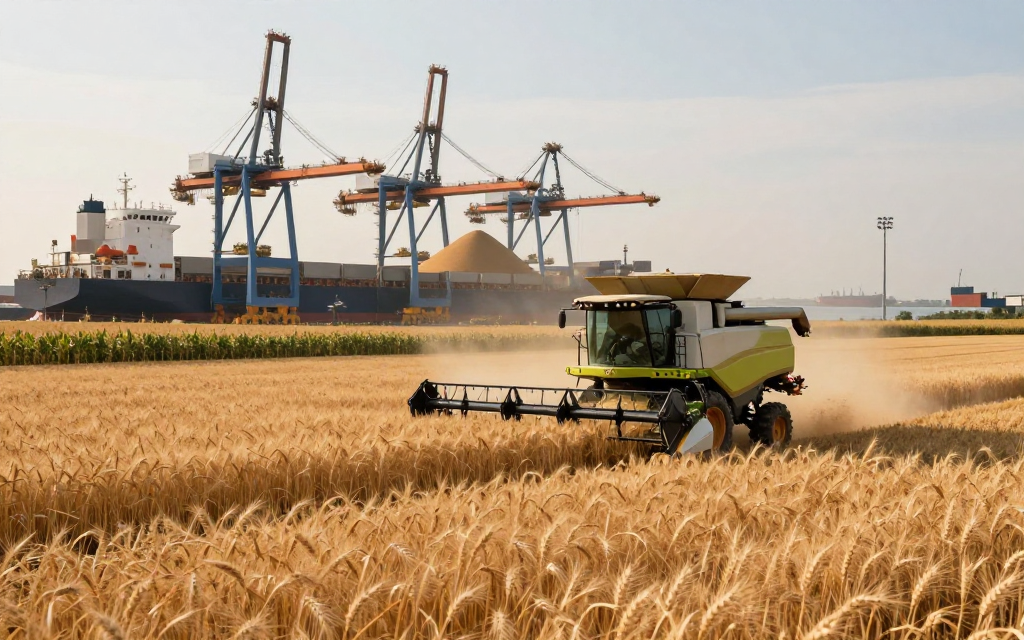
The grain complex hits its strongest levels of the month as wheat posts double-digit gains for a third consecutive session, South American soymeal faces a landmark EU GMO rejection crisis, Indonesia warns of a 1–2 MMT palm oil shortfall, and China quietly tightens fertilizer export enforcement — all converging on Wednesday's open.
Grains open Wednesday broadly higher: wheat is extending Tuesday's double-digit rally to fresh contract highs, corn is 1 to 2 1/2 cents firmer on spillover and Taiwan's overnight corn purchase, and soybeans reverse Tuesday's losses with 4 to 5 cent gains driven by the GMO soymeal withdrawal crisis and firm crush margins that have reached all-time highs at $3.67 3/4 using the CBOT formula. The session's single most market-moving structural development is the EU's flagging and withdrawal of multiple Argentine and Brazilian soymeal shipments for banned GMOs — a compliance crisis that directly opens the door for increased US and Ukrainian origin demand at a time when wheat's weather story and the biofuel demand complex are already providing substantial upside momentum.
Wheat Posts Third Consecutive Double-Digit Rally; Contract Highs Across All Three Exchanges
May '26 CBOT wheat closed Tuesday at $6.49, up 27 1/2 cents, and opens Wednesday up a further 6 3/4 cents at new contract highs — the third consecutive session of double-digit gains for the complex. KC HRW futures rose 18 to 29 1/2 cents on Tuesday with open interest falling 7,438 contracts, confirming short-covering rather than fresh long accumulation as the primary driver of the move. The fundamental backdrop remains unrelenting: the Brugler500 HRW state average at 244 — the second-lowest for this week since 2000 — is combining with 34% of the winter crop already headed, 13 percentage points ahead of normal. NOAA's 7-day QPF shows most of Kansas dry, with 1 to 2 inches forecast only for parts of Oklahoma and Texas — but with Oklahoma at 43% headed and Texas at 65%, the window for that moisture to benefit the crop is narrowing rapidly. Short-covering is running out of room to continue fuelling the rally without fresh buying stepping in, making Wednesday's price action a critical test of whether fundamental longs are willing to extend at these levels.
Australia and Canada Attaché Reports Project Major Wheat Crop Declines for 2026/27
Two USDA attaché reports released Tuesday simultaneously flagged steep forward supply reductions in two of the world's largest wheat exporters. Australia's 2026/27 wheat harvest is projected at 29 MMT — down 19% from 2025/26 — with exports cut to 23.5 MMT from 26 MMT, as El Niño uncertainty, rising input costs from the Iran war, and the end of last season's favorable yield run weigh on the outlook. Australia's attaché noted diesel and nitrogenous fertilizer prices have approximately doubled in the lead-up to planting. Canada's 2026/27 wheat harvest is projected at 36.159 MMT, down approximately 10% from the prior year's record yields, with exports at 28.5 MMT — down from 29.7 MMT — as farmers shift to soybeans, barley, and canola amid large wheat stocks and lower prices. Neither report is official USDA data ahead of the May 12 WASDE, but together they signal a meaningful tightening of 2026/27 global wheat export capacity from two major origins, adding medium-term fundamental support that reinforces the current weather-driven rally.
EU GMO Soymeal Crisis: Argentine and Brazilian Shipments Withdrawn — US and Ukraine Positioned to Gain
Six South American soymeal shipments — four Argentine and two Brazilian — have been flagged by the Netherlands in the EU's Rapid Alert System for Food and Feed for containing non-approved genetically modified organisms, with at least three cargoes already withdrawn. Argentina's agriculture ministry has raised "serious" concerns about Dutch testing methods, with CIARA-CEC chamber president Gustavo Idigoras claiming the detection methodology generates false positives. The banned GMO in question is HB4 — a drought-tolerant soy trait developed by Argentine biotech firm Bioceres, approved in Argentina and Brazil but not in the EU. The EU imported 9.9 MMT of Brazilian soymeal and 6.9 MMT of Argentine soymeal in 2024/25 — the two origins combined account for the overwhelming majority of EU soymeal supply, with Ukraine a distant third at 930,000 tons. If the Dutch testing methodology stands and more shipments are flagged, this is structurally the most significant near-term demand catalyst for US soymeal of the month, directly supporting Wednesday's 4 to 5 cent soybean gains and providing a fundamental demand-side justification for the recent rally in CBOT soymeal that was previously attributed primarily to biofuel demand.
Indonesia's Palm Oil Output Faces 1–2 MMT Decline on El Niño and Fertilizer Costs
GAPKI chairman Eddy Martono warned Wednesday that Indonesia's 2026 crude palm oil production could fall 1 to 2 MMT from 2025's 51.66 MMT record output, citing El Niño-related dryness and fertilizer prices up 30 to 50% since the Iran war began. Smallholder farmers — who account for 37% of Indonesia's plantation area — are reportedly reducing or postponing fertilizer applications due to cost pressure. The production shortfall risk arrives precisely as Indonesia's B50 biodiesel mandate, effective July 1, is projected to require approximately 3 million additional tons of palm oil per year for domestic biofuel blending. A simultaneous demand increase and supply reduction in the world's dominant palm oil producer is structurally supportive for all competing vegetable oil origins — soy oil, canola oil, and sunflower oil — and reinforces the record net long soy oil speculative position and the D4 RIN values above $1.90 per gallon, their highest level since late 2022.
China Tightens Fertilizer Export Enforcement; Ammonium Sulphate Now Being Inspected
China is stepping up customs inspections to close loopholes in its fertilizer export controls, with three traders confirming that ammonium sulphate — previously excluded from the export restrictions introduced in March — is now subject to customs inspection at Qingdao after exporters were found falsely declaring restricted urea and potash as the uncontrolled product. China exported $13 billion worth of fertilizers in 2025 and typically ships 5 to 5.5 million tons of urea annually. With domestic urea prices well below elevated global levels following the Hormuz disruption — creating a highly profitable export arbitrage — Beijing is actively preventing leakage through reclassification. Tighter enforcement closes the informal relief valve that market participants had been factoring into global fertilizer supply expectations, sustaining the structural upward pressure on urea prices that directly inflates crop production costs globally and reinforces the bullish medium-term input cost backdrop for all three crops.
China Replaces Agriculture Ministry Chief for Second Time in Two Years
China's Communist Party replaced Han Jun as the senior party official at the agriculture ministry with Zhang Zhu — a trained agronomist previously serving as deputy party secretary of Xinjiang — in the second such leadership change in under two years. Han's removal is the third ministerial-level agriculture reshuffle in six years, an unusually high turnover rate for a portfolio that sits at the intersection of food security, trade policy, and rural development. Zhang's background in Xinjiang — a region with significant grain and cotton production — and his prior agriculture-related roles in Ningxia signal a policy emphasis on domestic production. For grain markets, leadership continuity risk in China's agriculture ministry at a time of elevated import dependency and active trade tensions with the US adds a layer of policy uncertainty that warrants monitoring ahead of the May 14–15 Trump-Xi summit, which remains the most consequential near-term catalyst for Chinese US-origin soybean purchasing.
Biofuel Demand Acceleration Across Multiple Economies Keeps Soy Oil and Corn Supported
Wednesday's session features simultaneous biofuel demand expansion signals from three major economies. Brazil's E32 ethanol mandate — set to add 1 billion liters of anhydrous ethanol demand annually per UNICA — is advancing toward a formal CNPE council discussion in early May. India issued draft rules on Tuesday for E85 and E100 fuel provisions, expanding the regulatory pathway to higher ethanol blends after achieving E20 in 2025. US Chinese-origin used cooking oil imports are surging to supply the Trump administration's record biofuel blending requirements (RVOs), with soy oil recently hitting its highest price since November 2022 and D4 RIN values above $1.90 per gallon. CBOT crush margins at an all-time high of $3.67 3/4 confirm that the processing economics are signalling unprecedented profitability. Analysts warned that domestic feedstock supply is insufficient for the new US RVO targets — "we have to import" — meaning the soy oil biofuel demand bid is structural and persistent rather than tactical.
Brazilian Safrinha Corn Enters Critical Phase Under Worsening Dry Conditions
Brazil's central growing states of Mato Grosso and Goiás are experiencing very hot and dry conditions as the wet season ended approximately two weeks early, with the safrinha corn crop now in its most moisture-sensitive period. The weather outlook for central Brazil offers minimal relief: fronts moving up from Argentina may provide occasional showers, but soil moisture is described as running out rapidly — a "poor sign for safrinha corn" per the weekly weather analysis. Hedgepoint simultaneously raised its Brazilian soybean estimate to 181 MMT — up 1.5 MMT — citing favorable weather in Mato Grosso, Goiás, and Bahia offsetting losses in Rio Grande do Sul, confirming that the soybean harvest outcome has been excellent. The divergence between the completed, record-setting soy harvest and the deteriorating safrinha corn outlook is sharpening: if central Brazil does not receive meaningful frontal rainfall in early May, the CONAB safrinha corn estimate of approximately 109 MMT faces material downside pressure, directly tightening the 2026/27 global corn balance ahead of the May 12 WASDE.
Wheat
May '26 CBOT wheat closed Tuesday at $6.49, up 27 1/2 cents, and opens Wednesday up 6 3/4 cents at new contract highs — the third consecutive double-digit session gain as the HRW drought deterioration story builds momentum. The Brugler500 HRW state average at 244 — the second-lowest reading for this week in 25 years — combined with 34% heading pace at 13 points ahead of normal, leaves the crop advancing under critical drought stress with no meaningful Plains precipitation in the 7-day QPF for most of Kansas. Australia's USDA attaché projecting a 19% crop decline to 29 MMT and Canada's 10% reduction to 36.159 MMT add forward supply tightening on top of the current-season weather premium. EU soft wheat exports at 19.28 MMT from July 1 to April 24 — up 1.18 MMT year-on-year — confirm European competitive pressure continues, but it is not sufficient today to cap a market in full weather-driven rally mode.
Corn
May '26 CBOT corn closed Tuesday at $4.65 1/4, up 4 1/2 cents, and opens Wednesday up 1 1/4 cents as spillover wheat support and fresh Asian demand maintain a bid. Taiwan purchased 65,000 MT of US corn overnight in its tender, and EIA ethanol data due Wednesday is expected to show production slightly higher at 1.048 million barrels per day — a modestly constructive ethanol demand print. Corn planting at 25% — 6 percentage points ahead of average — and open interest up 6,779 contracts on Tuesday despite 53,411 May contracts rolling off confirm that deferred-month buying is active and demand for forward coverage is intact. The safrinha dryness story in central Brazil is the session's most important developing bullish corn variable: if soil moisture runs out before frontal rainfall arrives, the corn market's current-season supply estimate faces the first meaningful downside revision of the year.
Soybeans
May '26 CBOT soybeans closed Tuesday at $11.73, down 4 1/4 cents, and open Wednesday up 4 1/2 cents as the EU GMO soymeal crisis reverses the Turnaround Tuesday weakness. Crush margins at an all-time high of $3.67 3/4 and D4 RIN values above $1.90 per gallon confirm that processing economics are at record profitability. The GMO withdrawal of Argentine and Brazilian soymeal shipments to the EU — with 9.9 MMT of Brazilian and 6.9 MMT of Argentine soymeal at risk if compliance standards are enforced broadly — is the session's single most structurally significant demand catalyst for US-origin soymeal and beans. Hedgepoint's 181 MMT Brazilian soybean estimate and ANEC's April export forecast reduced to 15.87 MMT — down 0.52 MMT from the prior week — confirm the bearish supply backdrop remains intact structurally, but Wednesday's session is being driven by the GMO demand disruption rather than the supply narrative.