




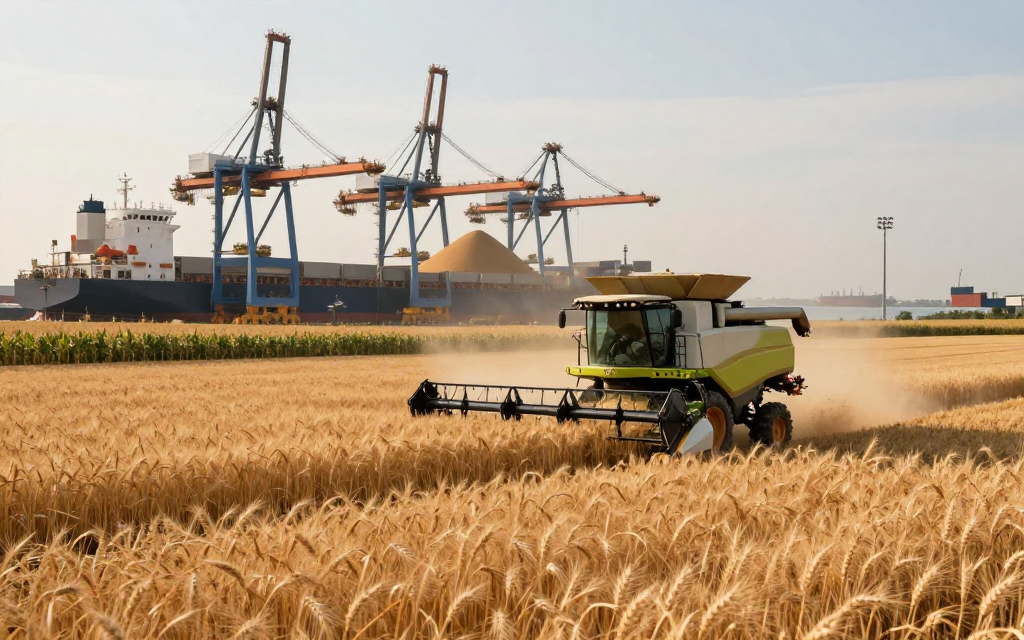
Grain markets head into Friday's close on firmer footing, with soybeans leading gains of 16 to 17 cents in front months, wheat up 4 to 9 cents across all three exchanges, and corn gaining 3 to 5 cents. The session's tone is supportive but measured, with traders reluctant to build large positions ahead of Tuesday's May WASDE — the first report of the season to carry full 2026/27 US and world balance sheets alongside the final old crop revisions.
May WASDE Preview: New Crop Balance Sheets Are the Week's Central Event
Tuesday's May WASDE is the most consequential scheduled event of the coming week, and Friday's positioning reflects awareness of that risk. For wheat, a Bloomberg analyst survey points to old crop US ending stocks falling 8 mbu to 930 mbu, with new crop 2026/27 US stocks projected at 845 mbu — though with a wide range of 759 to 955 mbu reflecting genuine uncertainty about the new crop supply picture. For corn, old crop carryout is expected to nudge up marginally to 2.13 bbu versus the April figure of 2.127 bbu, with 2026/27 US stocks seen at 1.942 bbu on average, ranging from 1.776 to 2.11 bbu — a spread wide enough to generate a meaningful market reaction in either direction. Soybeans are expected to show old crop stocks broadly steady at 349 mbu against April's 350 mbu, with new crop 2026/27 stocks projected at 366 mbu and a range of 308 to 479 mbu. The breadth of analyst ranges across all three crops signals that the market has not converged on a consensus new crop view, making Tuesday's release a live volatility event.
South Korean Corn Tender: Incremental Demand Supports Friday's Tone
Overnight, a South Korean importer purchased 136,000 MT of corn in a tender — the same destination and approximate volume that provided demand support during the prior weeks' sessions. The purchase is a consistent signal of end-user demand at current price levels and adds to corn's 28% year-on-year export commitment advantage. For Friday specifically, the tender provides a tangible demand anchor that helps sustain the morning's 3 to 5 cent corn gains. The national average cash corn price is up 4 1/4 cents to $4.30 — the strongest cash level in recent sessions — reflecting both the tender activity and tightening nearby basis as the marketing year advances.
Corn Export Commitments Running Strong, Shipment Pace Accelerating
Thursday's Export Sales data confirmed that corn remains the export standout of the three crops. Marketing year corn commitments of 77.063 MMT are running 28% above year-ago levels and at 92% of USDA's full-year projection — only 2 percentage points behind the five-year average pace. Crucially, shipments of 56.14 MMT are now 29% ahead of year-ago and tracking at 67% of the USDA number, 3 percentage points ahead of the average shipping pace. The combination of strong commitment pace and accelerating physical shipments is a firm demand-side foundation for corn heading into the new crop balance sheet reveal. Any upward revision to the USDA corn export estimate in Tuesday's WASDE would not be a surprise given current pace, and could provide a supportive catalyst.
Soybean Export Lag Persists: Shipments Running 23% Below Year-Ago
The soybean export picture remains the weakest of the three crops and is the key bearish counterweight to Friday's sharp 16–17 cent rally. Commitments of 38.92 MMT are 18% below last year and at only 93% of USDA's projection, lagging the five-year average pace by 5 percentage points. More critically, shipments of 33.24 MMT are 23% below year-ago — at just 79% of USDA's number and 9 percentage points behind the average shipping pace. The structural cause remains China's reduced purchasing of US origin soybeans, and Friday's 100 overnight deliveries issued against May beans adds mild near-term supply pressure. The WASDE's old crop carryout expectation of steady at 349–350 mbu reflects this demand weakness, and any downside surprise in shipments or a cut to the export projection on Tuesday would reinforce the bearish soybean export narrative.
Wheat Commitments Cross 100% of USDA Target: Demand Pace Normalizing
Wheat's export picture has quietly strengthened, with total old crop commitments of 24.94 MMT now at 102% of the USDA estimate — at the five-year average sales pace of 103%. Actual shipments of 22.056 MMT represent 90% of the USDA number and are just 1 percentage point behind normal. After weeks of export shipments running sharply below year-ago — including the 47.62% year-on-year deficit reported for the week ending April 9 — the normalization of commitment pace is a mildly supportive development for wheat heading into Tuesday's WASDE. The Bloomberg survey expectation of an 8 mbu reduction in old crop ending stocks to 930 mbu would be a modest tightening from the April WASDE's surprise increase to 938 mbu, and would partially unwind the bearish reaction that followed last month's report. The Kansas HRW wheat tour next week will provide additional real-world yield visibility ahead of harvest.
Safras Cuts Brazil Second Corn Crop: Safrinha Yield Risk Now in Analyst Estimates
Safras e Mercado reduced its Brazilian corn crop estimate by 1.6 MMT to 140.11 MMT, with the second crop — the safrinha — specifically cut by 1.5 MMT to 99.09 MMT. The revision confirms that the pollination-period weather stress tracked across late April and early May has begun to feed through into official and private forecaster estimates. The safrinha cut from Safras follows the fertilizer-linked reductions flagged by CONAB and Rabobank in earlier weeks, and collectively the Brazil second crop estimates are now trending meaningfully lower than the bumper outputs originally projected. For corn, this is a gradually accumulating bullish production narrative from Brazil that partially offsets Argentina's record 67 MMT harvest. The extent of further safrinha downward revisions depends on whether late-season rainfall in central Brazil delivered any recovery, and that data flow will remain a market variable heading into May WASDE and beyond.
Kansas HRW Tour Next Week: Real-World Yield Check on a Stressed Crop
The annual Kansas Hard Red Winter wheat tour begins next week, providing the first systematic on-the-ground yield assessment of the US HRW crop after a growing season defined by drought stress in western Plains areas and highly variable precipitation. Winter wheat condition has been tracking near the seventh-lowest start since 1990 at 34% good/excellent with the Brugler500 index at 295 — and the tour's county-level yield estimates will either validate or challenge that bearish crop quality signal. KC HRW is up 4 to 9 cents on Friday, outperforming Chicago SRW's 4 to 7 cent gains, in part reflecting pre-tour positioning risk. A disappointing tour outcome — lower-than-expected yield samples across key western Kansas counties — could accelerate KC's outperformance and draw speculative buying into what has been a market trading well below its potential output risk premium.
Soybean Rally Led by Broad Complex Strength: Meal and Oil Both Positive
Friday's soybean move of 16 to 17 cents in front months is notable for its composition — unlike several prior sessions where soymeal rallied while soy oil declined, Friday sees both meal up $1.50 to $2.00 and soy oil up 40 to 60 points. The unified complex strength suggests the rally is not a meal-versus-oil rotation trade but a broader soybean demand signal, possibly linked to positioning ahead of Tuesday's WASDE new crop balance sheet. The national average cash bean price is up 17 cents to $11.42 3/4. The source does not provide a specific macro or fundamental catalyst for the magnitude of Friday's soybean move beyond the WASDE positioning and complex-wide strength, so the rally should be interpreted with caution until Tuesday's data either validates or deflates the optimism.
Crop Futures Wrap
Wheat — May '26 CBOT SRW wheat is at $6.06 1/2, up 4 3/4 cents at Friday midday. Chicago SRW is 4 to 7 cents higher, KC HRW is 4 to 9 cents in the green, and MPLS spring wheat is up 5 to 7 cents — a uniform bid across all three exchanges that reflects broad pre-WASDE positioning rather than a crop-specific catalyst. Old crop export commitments crossing 102% of the USDA estimate provide a quiet demand-side validation, and KC's relative outperformance is partly explained by pre-tour risk ahead of next week's Kansas HRW yield survey. The Bloomberg WASDE survey projects a modest 8 mbu tightening to 930 mbu for old crop stocks — a partial reversal of last month's bearish surprise — that would be directionally supportive if confirmed Tuesday.
Corn — May '26 CBOT corn is at $4.56 1/4, up 3 1/2 cents at Friday midday. The national average cash corn price is up 4 1/4 cents to $4.30 — a notably strong cash level — supported by overnight South Korean tender activity of 136,000 MT and the strongest export commitment pace of the three crops at 92% of USDA's projection. Safras' 1.5 MMT reduction to Brazil's safrinha to 99.09 MMT provides a gradual supply-side tightening signal from South America that adds to corn's fundamental support. The May WASDE new crop projection — expected at 1.942 bbu for 2026/27 US stocks, with a wide 1.776–2.11 bbu range — is the key variable that will determine whether Friday's gains can be sustained or reversed early next week.
Soybeans — May '26 CBOT soybeans are at $11.89 1/2, up 12 1/2 cents at Friday midday, with front months showing 16 to 17 cent gains and both soymeal ($1.50–$2.00 higher) and soy oil (up 40–60 points) contributing positively. The 100 overnight May deliveries add mild nearby supply pressure but have not dampened the rally. The national average cash bean price is up 17 cents to $11.42 3/4. Export shipments running 23% below year-ago and commitments lagging the five-year average pace by 5 percentage points remain the structural bearish offsets. New crop 2026/27 US stocks in Tuesday's WASDE are expected at 366 mbu — if realized toward the lower end of the 308–479 mbu range, Friday's rally could find continuation; toward the upper end, the move is likely to partially reverse.