




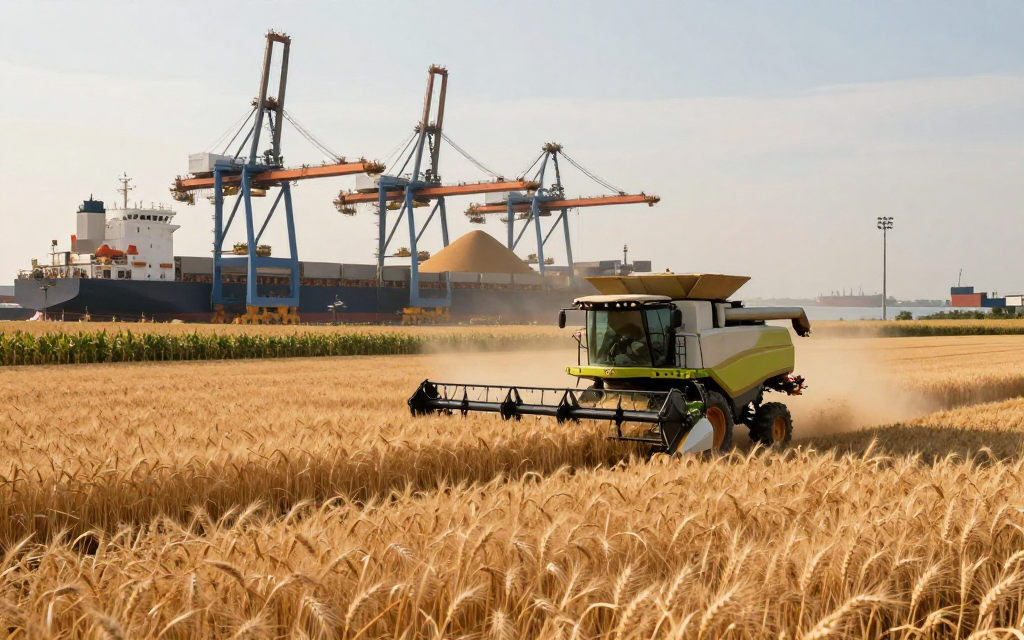
Corn leads the early advance as disappointing US crop tour results, a softer dollar and renewed Black Sea risk give the grain complex a firmer tone.
Chicago grains are starting Thursday, 20 August, mostly higher, with corn extending to three-month highs and soybeans reaching fresh monthly highs. Traders today are focused on the final stages of the Pro Farmer Crop Tour, US export demand, increasingly crowded speculative positioning and geopolitical risk around Ukraine, while a weaker dollar provides broader support to agricultural commodities.
Weaker Dollar and Higher Energy Add Broad Commodity Support
Agricultural markets are benefiting from a moderately weaker US dollar, which fell to a fresh three-month low overnight and improves the relative competitiveness of US commodities on the export market. Energy is also providing support, with Oct-26 WTI crude up $2.85 at $87.25 per barrel as geopolitical tensions with Iran lift the energy complex. The combination is constructive for grains and particularly supportive for vegetable oils and biofuel-linked markets, although slightly weaker US equities signal that broader risk appetite remains cautious.
US Weather Keeps Yield Risk in Focus
Heavy rainfall extended from eastern Nebraska through the central and eastern Corn Belt over the past 24 hours, with 1–3 inches reported across already saturated fields from east-central Illinois through south-central Ohio. Lighter rainfall is expected across much of the Midwest during the coming week, while temperatures remain normal to below normal in northern areas and above normal farther south. The wetter pattern is not an immediate supply shock, but saturated fields add another layer of uncertainty as traders reassess yield potential ahead of harvest.
Crop Tour Numbers Strengthen the Bullish Corn Narrative
Corn is receiving the clearest fundamental support from the Pro Farmer Crop Tour. Illinois yield was estimated at 184.2 bpa, sharply below last year's 199.6 bpa and the three-year average of 199.2 bpa, while the three western Iowa districts surveyed were generally 4–8 bushels below year-ago levels. Those figures are encouraging traders to question whether current production expectations can be maintained, with the final Iowa and Minnesota results now an important intraday catalyst.
Fund Buying Supports Corn, but Positioning Is Becoming Crowded
Speculative traders bought another 23,000 corn contracts in the previous session, taking the estimated long position back toward 260,000 contracts, which would be the largest in roughly three months if confirmed. The move shows that funds are increasingly embracing the lower-production and stronger-usage narrative. However, open interest fell by just over 4,000 contracts, and the expanding long position raises the risk of sharper volatility if incoming crop data fail to confirm the current bullish expectations.
Black Sea Disruptions Add Support to Wheat and Corn
Black Sea logistics remain another supportive factor. Ukraine has shipped only around 500,000 MT of grain since 1 August, roughly 20% of its potential capacity, while another dry cargo vessel near the port of Chornomorsk was struck by the Russian military. Any sustained disruption to Ukrainian export flows could redirect demand toward competing origins and provide support to both wheat and feed grain markets.
Soybeans Balance Yield Concerns Against Strong Global Competition
Soybeans are also finding support from crop uncertainty. Illinois pod counts averaged 1,430 pods per 3×3-foot square, below last year's 1,479 but above the three-year average of 1,390, while the western Iowa districts were all below year-ago levels. The final Iowa and Minnesota results will therefore be closely watched, particularly because the US balance sheet has limited room for yields to fall materially below the current 52.7 bpa estimate without tightening stocks sharply.
Brazil Outlook and US Export Competitiveness Shape Soybean Demand
South American supply remains a major counterweight to US production concerns. Brazil's 2026/27 soybean harvest is forecast at 181.7 MMT, below the 186 MMT estimate referenced in the market, with harvested area expected to rise only marginally to 49.2 million hectares. At the same time, US Gulf FOB soybean offers remain $0.30–$0.40/bu below Brazilian offers through the end of 2026, giving US beans a competitive export advantage and increasing the importance of forthcoming demand, including Chinese buying.
Wheat Finds Support Despite Improving Russian Harvest Progress
Wheat is trading higher across all three US classes as Black Sea risk combines with a reduced European production outlook. Russian August wheat shipments are expected to be the lowest in 16 years, although the country's grain harvest is approaching 100 MMT and local fuel shortages are reportedly being resolved, limiting the bullish supply argument. At the same time, EU and UK wheat production has been reduced 2.3% to 145.5 MMT, including 137.9 MMT of soft wheat and 7.6 MMT of durum, adding support to the European supply outlook.
Export Demand Is the Next Test for the Rally
Today's US export sales will provide an important test of whether higher futures prices are beginning to ration demand. Combined old- and new-crop corn sales are expected at 20–70 million bushels, soybean sales at 35–85 million bushels, soybean meal at 150,000–500,000 MT and soybean oil between net cancellations of 10,000 MT and sales of 10,000 MT. Wheat sales are expected in a range of 8–16 million bushels. Strong numbers would reinforce the current rally, while disappointing demand could encourage profit-taking after the recent move higher.
Wheat Futures
Wheat is starting Thursday firmer across the three US classes. Sep-26 Chicago wheat is up 5 1/2 cents at $6.85 3/4/bu, Sep-26 KC wheat is up 3 cents at $7.65/bu, and Sep-26 Minneapolis wheat is up 6 cents at $7.00/bu. Black Sea shipping risk, slower Russian export expectations and the reduced EU/UK crop outlook are providing support, while improving Russian harvest progress limits the upside.
Corn Futures
Corn is leading the grain complex higher, with Sep-26 corn up 5 1/2 cents at $4.78 1/2/bu and Dec-26 corn up 5 1/2 cents at $5.03 1/2/bu, taking both contracts to three-month highs. The strongest early driver is the disappointing Illinois and western Iowa crop tour data, reinforced by continued speculative buying and a weaker dollar. Final Iowa and Minnesota crop tour results will be a key test for whether the rally can extend.
Soybean Futures
Soybeans are also firmer, with Sep-26 soybeans up 1 3/4 cents at $12.24/bu and Nov-26 up 3 1/2 cents at $12.40 3/4/bu, both reaching new highs for the month. Crop tour pod counts, competitive US Gulf offers and concern that even a modest US yield reduction could tighten the balance sheet are supporting prices, while expectations for another very large Brazilian crop remain the main supply-side restraint. Sep-26 soybean meal is up $1.50 at $320.40, while Sep-26 soybean oil is 47 points higher at 70.33.